Stem Cell Hair Treatment
Stem cell therapy for hair restoration is a primary focus of regenerative medicine in 2026, offering a solution for those who seek to improve hair density without traditional surgery. This treatment utilizes mesenchymal stem cells to target the cellular environment of the scalp. Unlike topical treatments that only address the surface, stem cells work by repairing the underlying follicular structure and stimulating the dermal papilla cells, which are responsible for hair growth and thickness.
The mechanism of biological regeneration involves several key physiological transitions:
- Follicular Reactivation: The introduction of potent stem cells triggers a signaling process that pushes dormant follicles from the resting phase into the active growth phase. This is particularly effective for patients experiencing thinning where the follicles are still present but have lost their productive capacity.
- Tissue Repair and Quality: Stem cells secrete essential cytokines and growth factors that improve the health of the scalp tissue. By increasing collagen production and enhancing the vascular network around the roots, the treatment ensures a stable and nutrient-rich foundation for both existing and new hair.
- Reversing Miniaturization: The most significant impact of stem cell therapy is its ability to combat the shrinking of follicles caused by genetic factors. By reinforcing the cellular matrix of the follicle, the therapy helps the hair shaft regain its original diameter and strength.
What are Stem Cells?
At their core, stem cells are the body’s raw materials unspecialized cells from which all other cells with specialized functions are generated. Think of them as a blank slate or a universal “master cell.” While a heart cell can only function within the cardiac system and a skin cell is dedicated to protection, a stem cell possesses the unique potential to transform into many different types of cells based on the signals it receives from its environment.
This transformative power is governed by two extraordinary properties that distinguish them from any other cell in the human anatomy. First is their capacity for proliferative self-renewal, allowing them to create identical copies of themselves indefinitely. Second is differentiation, the biological process of maturing into specialized cells like those found in the hair follicle’s dermal papilla.
In modern hair restoration, we specifically focus on mesenchymal stem cells. These aren’t just “building blocks”; they act as sophisticated communication hubs. They release a steady stream of molecular signals that tell surrounding, weakened tissues to begin a process of self-repair. By introducing these cells into a thinning scalp, the goal is to leverage this natural “software” to reboot the hair growth cycle at a fundamental, microscopic level.
7 Types of Stem Cell Hair Restoration
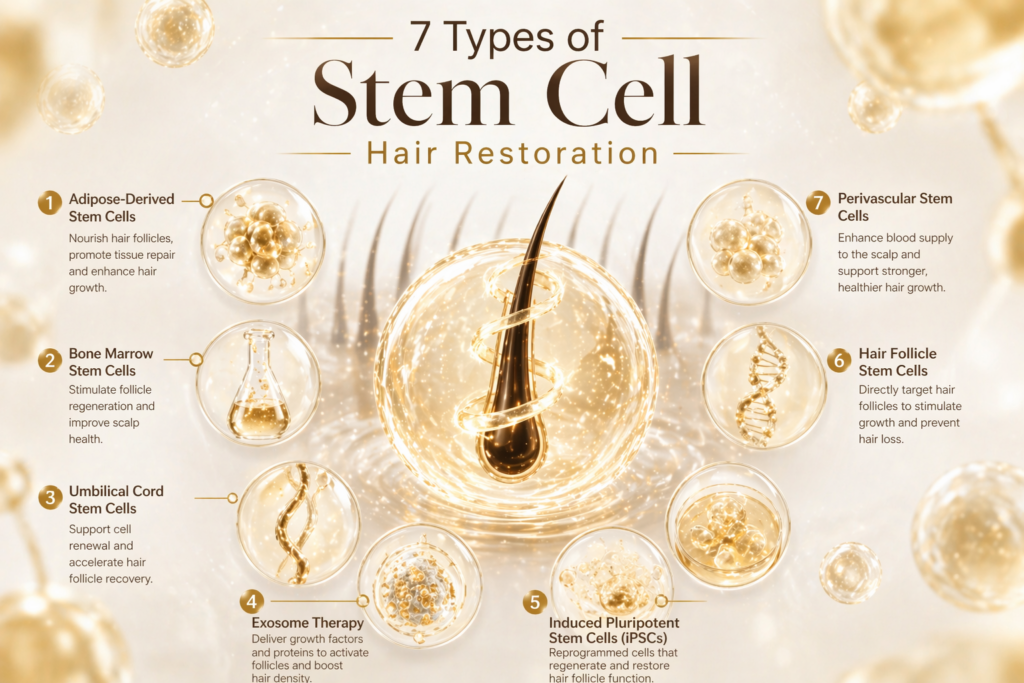
The evolution of regenerative medicine has led to a diverse range of applications for stem cell technology. Each method varies in its source, concentration, and delivery mechanism, tailored to different stages of hair thinning.
1. Adipose-Derived Stem Cells (ADSCs)
One of the most common surgical stem cell applications involves extracting cells from the patient’s own fat tissue, usually from the abdomen or thigh. This fat is processed to isolate a “stromal vascular fraction,” which is exceptionally rich in mesenchymal stem cells. When injected into the scalp, these cells provide a robust structural framework and long-term signaling to follicles.
2. Bone Marrow-Derived Mesenchymal Stem Cells
Historically the “gold standard” in regenerative therapy, these cells are harvested from the bone marrow. They are known for their high potency in reducing inflammation and promoting vascular health. For hair restoration, they are utilized to shock the scalp into a healing state, making them ideal for patients with significant inflammatory hair loss.
3. Alloblast (Neonatal Fibroblasts)
This cutting-edge approach uses high-purity, laboratory-grown stem cells derived from neonatal tissue. The primary advantage here is the “youth” of the cells; because they are young, they possess a much higher proliferative capacity and a more aggressive regenerative signal than cells harvested from an adult patient’s own body.
4. Follicular Unit Stem Cell Extraction
In this micro-procedure, a few hair follicles are harvested from the donor area, and the stem-cell-rich portion of the bulb is isolated and multiplied in a lab or processed through a centrifuge. These cells are then re-injected into thinning areas. Essentially, you are using the most productive parts of your “immortal” hair to save the thinning ones.
5. Umbilical Cord Blood Stem Cells
Utilizing mesenchymal cells derived from umbilical cord tissue (post-birth, ethically sourced), this type of restoration offers a “universal” regenerative signal. These cells are prized for their purity and are often used in advanced clinical settings to provide a dense concentration of growth factors without the need for a donor site on the patient’s body.
6. Exosome-Concentrated Therapy
While technically a cell-free byproduct of stem cells, Exosome therapy is often categorized here because it utilizes the “messengers” produced by stem cells. By stripping away the cell itself and using only the tiny vesicles containing the genetic instructions for growth, this method provides a highly targeted, liquid-gold concentrate that mimics the effect of live stem cells.
7. Plant-Based Phyto-Stem Cells
Typically found in high-end topical applications and professional-grade serums, these are derived from resilient plant species (like specific Swiss apples or argan trees). While they do not transform into human hair cells, they act as powerful antioxidants that protect human scalp stem cells from UV damage and oxidative stress, serving as a vital maintenance layer in a comprehensive treatment plan.
How Much Does a Stem Cell Hair Treatment Cost?
The cost of stem cell hair restoration is not fixed, as it fluctuates based on the specific technology used, the source of the cells, and the geographical location of the clinic. Because these treatments involve high-level laboratory processing or specialized surgical extraction, they generally command a higher price point than standard therapies like PRP.
In 2026, the global market shows a significant price variance. In the UK and USA, a single session of adipose-derived or bone marrow stem cell therapy can range from $5,000 to $12,000, often making it a significant investment. These costs are driven by the intensive laboratory protocols and the high overhead of medical facilities in these regions.
For international patients, regions like Turkey offer a strategic advantage, balancing pharmaceutical-grade quality with more accessible pricing. In a specialized clinical setting, you can expect the following estimated price ranges:
- Alloblast (Neonatal) Treatments: Generally priced between $1,500 and $3,000 per session, depending on the concentration and area of application.
- Autologous (Patient-Derived) Stem Cells: Surgical extraction and immediate re-injection typically range from $2,000 to $4,500.
- Exosome Packages: Often used as a high-potency alternative or add-on, these sessions usually fall between $800 and $1,800.
When evaluating cost, it is vital to look beyond the sticker price. A lower-cost session using poorly concentrated “kits” will not yield the same biological signaling as a session utilizing certified laboratory-grown cells. The true value lies in the potency of the cellular signal, which determines whether you will see actual density improvement or merely temporary stabilization. Investing in a higher-tier treatment often results in a better long-term “cost-per-hair” ratio by reducing the need for future surgical interventions.
Who Is a Good Candidate for Stem Cell Hair Loss Therapy?
Not every stage of hair loss requires the same biological intervention. Determining if you are a suitable candidate for stem cell therapy depends largely on the current state of your hair follicles and your long-term restoration goals.
The ideal candidates for this treatment typically fall into these categories:
- Early to Mid-Stage Thinning: Stem cells work best when there are still active, albeit weakened, follicles present. If you are noticing a widening part, a thinning crown, or a loss of overall volume, stem cells can “reboot” these follicles before they disappear entirely.
- Diffuse Hair Loss: Unlike surgery, which is better for defined areas like a receding hairline, stem cell therapy is excellent for general thinning across the entire scalp, often seen in Female Pattern Hair Loss.
- Post-Hair Transplant Patients: Those who have already undergone surgery use stem cell therapy to protect their investment. It strengthens the newly transplanted grafts and prevents further loss of the surrounding native hair.
- Non-Surgical Seekers: If you are not a candidate for surgery due to a lack of donor hair or if you simply prefer a needle-based, non-invasive approach with zero downtime, this is the most advanced alternative available.
Essentially, if your follicles are miniaturized but not yet extinct (total baldness with smooth skin), you are a prime candidate for the regenerative signaling that stem cells provide.
Risks and Side Effects of Stem Cell Hair Treatment
While stem cell hair restoration is celebrated for its non-invasive nature and high safety profile, like any medical procedure involving injections and biological materials, it carries specific considerations. Understanding these risks is essential for setting realistic expectations and ensuring a safe recovery.
Common and Minor Reactions
The most frequent side effects are localized to the injection sites and typically resolve within 24 to 48 hours:
- Localized Swelling: A natural inflammatory response as the scalp reacts to the introduction of new cellular material.
- Tenderness and Redness: Mild sensitivity or a “tight” sensation across the scalp is common immediately following the session.
- Pinpoint Bruising: Small bruises may occur at the entry points, particularly in patients with sensitive skin or those taking blood-thinning supplements.
Procedure-Specific Risks
Depending on the type of stem cell therapy chosen, there are different risk factors involved:
- Infection: Any procedure that breaks the skin barrier carries a minor risk of infection. This is mitigated by performing the treatment in a sterile, clinical environment using medical-grade equipment.
- Site Morbidity (for Autologous treatments): If cells are harvested from your own fat (Adipose) or bone marrow, there are additional risks associated with the donor site, such as temporary soreness, bruising, or minor scarring at the extraction point.
- Unpredictable Results: Biological treatments rely on the body’s individual response. Factors like age, smoking habits, and underlying hormonal imbalances can influence how effectively the stem cells “communicate” with your follicles, meaning results can vary between patients.
The Safety of Alloblast and Exosomes
In 2026, the move toward lab-purified stem cells (Alloblast) and cell-free vesicles (Exosomes) has further reduced safety concerns. Because these products are screened for pathogens and standardized for potency in controlled environments, the risk of an adverse immune reaction is extremely low. Unlike synthetic chemicals, these treatments use signals that the human body inherently recognizes, making “rejection” virtually non-existent in clinical practice.